



A wireless RF remote can add a new control point on a boat without pulling another long switch cable back to the helm. The receiver can be installed close to the accessory, keeping much of the wiring local and making refits easier.
The important part is deciding what the receiver should control directly, when to use a separate relay or contactor, and where to install the receiver for reliable operation.
Best for
Lighting, pumps, hatches and retrofit control points
Main benefit
Less control cable pulled through the boat
Heavy loads
Use the RF receiver to command a relay or contactor
Related guide: for the basic switch-and-relay logic first, read When Should I Use a Switch, and When Should I Use a Relay?
What is an RF remote switch on a boat?
An RF remote switching system normally has two parts: a handheld transmitter and a receiver with one or more switched outputs.
Pressing a button on the transmitter sends a radio-frequency command to the receiver. The selected receiver output then turns ON, OFF or operates momentarily, depending on how that channel is configured.
Basic logic: Remote control → RF receiver → accessory or separate power relay
Transmitter
The handheld remote sends the command without needing a physical control cable between the user and receiver.
Receiver
The receiver detects the RF command and switches the selected output channel.
Output
The output can operate a suitable accessory directly or command a separate relay or contactor.
Baywatt 4-channel wireless remote switch
The Baywatt system is designed for 12V and 24V DC boat circuits. It uses 868 MHz RF rather than Wi-Fi or Bluetooth, so the handheld transmitter communicates directly with the receiver.
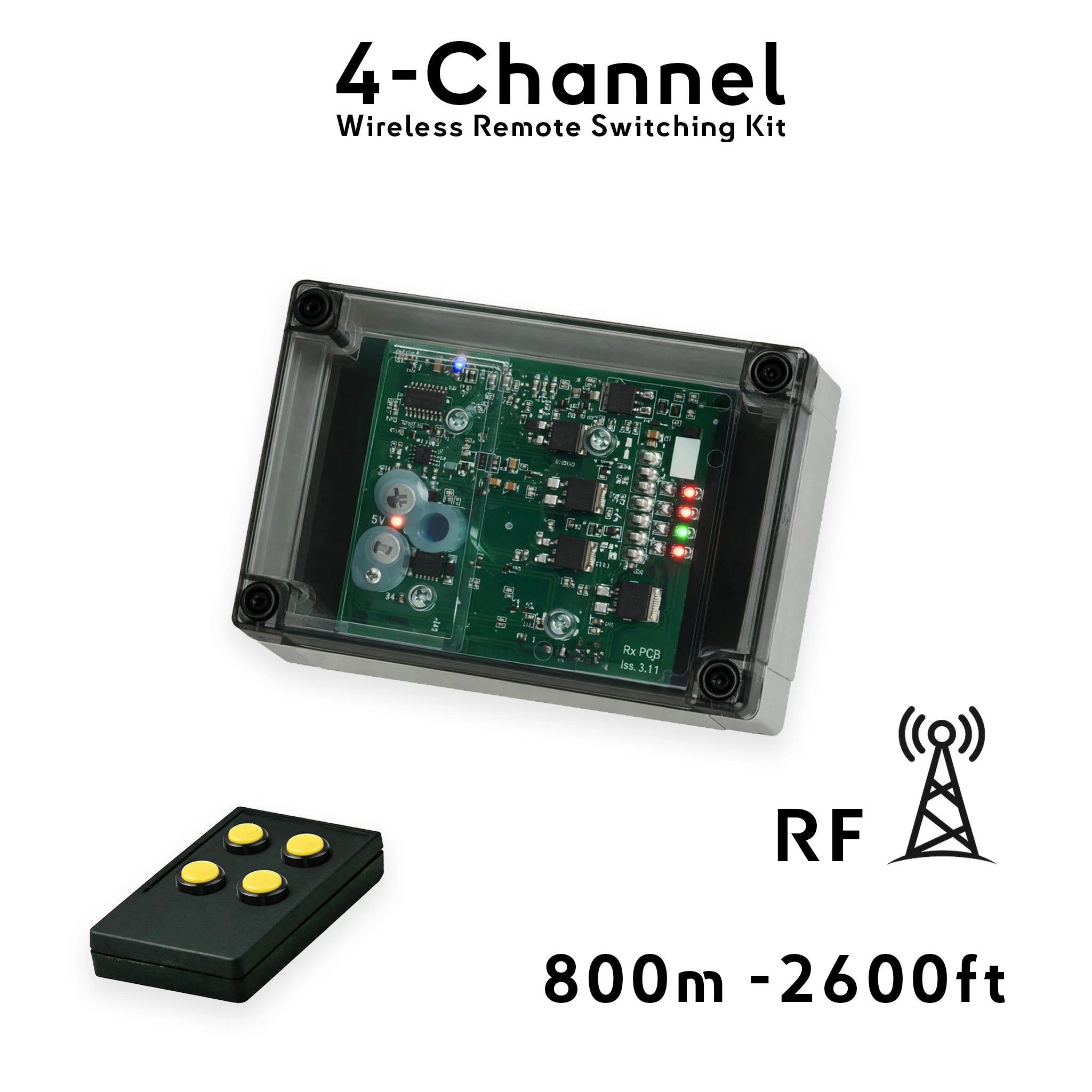
| Specification | Value |
|---|---|
| System voltage | 12 / 24 V DC |
| Frequency | 868 MHz RF |
| Channels | 4 |
| Receiver rating | Up to 30A per channel |
| Channel modes | ON/OFF or MOM/OFF per channel |
| Advertised range | Up to 800 m / 2600 ft, depending on conditions |
| Controller protection | IP66 / IP67 |
Why wireless control can simplify boat wiring
The practical advantage is not simply being able to operate an accessory from a remote. The receiver can be positioned closer to the equipment it controls.
On a refit, running a new cable from the helm to another part of the boat can mean opening lockers, removing panels and finding space inside already crowded cable routes. With an RF receiver close to the load, the control signal no longer needs that long physical route.
Less cable to pull
A new control point does not necessarily require another long switch cable back to the dashboard.
Easier refits
Useful when adding accessories after the boat has already been built and access to existing cable routes is difficult.
Local troubleshooting
Installing the receiver near the load can make power, output and accessory checks easier to perform.
The useful way to think about RF control: it is not just a remote-control feature. It can also be a wiring-layout tool.
Should the RF remote replace the local switch?
Not necessarily. In many installations, the wireless remote works best as an additional control point rather than the only way to operate the accessory.
A physical switch can remain at the helm or near the equipment while the RF receiver provides remote operation from the cockpit, dock, cabin entrance or another useful position.
| Control method | Good use | Consideration |
|---|---|---|
| Local switch only | Simple circuits close to the dashboard | Needs physical wiring to each control point |
| RF remote only | Non-critical convenience functions | Receiver power and remote operation become necessary |
| Local switch + RF | Many practical retrofit installations | Keeps a physical control point while adding remote operation |
Can the RF receiver switch the accessory directly?
First check the accessory current and the receiver output rating. A receiver rated for the load may be able to switch it directly, but the circuit still needs correctly sized cable and suitable overcurrent protection.
For high-current equipment such as a windlass, thruster or large hydraulic load, the RF receiver should normally send only the command. A correctly sized relay, solenoid or contactor carries the main load.
Heavy-load logic: RF remote → receiver → contactor or power relay → load
Important: a 30A receiver rating does not mean every 30A circuit should automatically be connected directly. Check continuous and starting current, cable size, protection and the equipment manufacturer's requirements.
One 4-channel receiver or four separate receivers?
The Baywatt system can use a centralized 4-channel receiver or several 1-channel receivers. The useful choice depends mainly on where the accessories are located.
Option A — one 4-channel receiver
Best when: several accessories are grouped in the same area.
One receiver provides four outputs from one central location.
Option B — four 1-channel receivers
Best when: accessories are spread around the boat.
Each receiver can be installed closer to its own load, reducing long output cable runs.
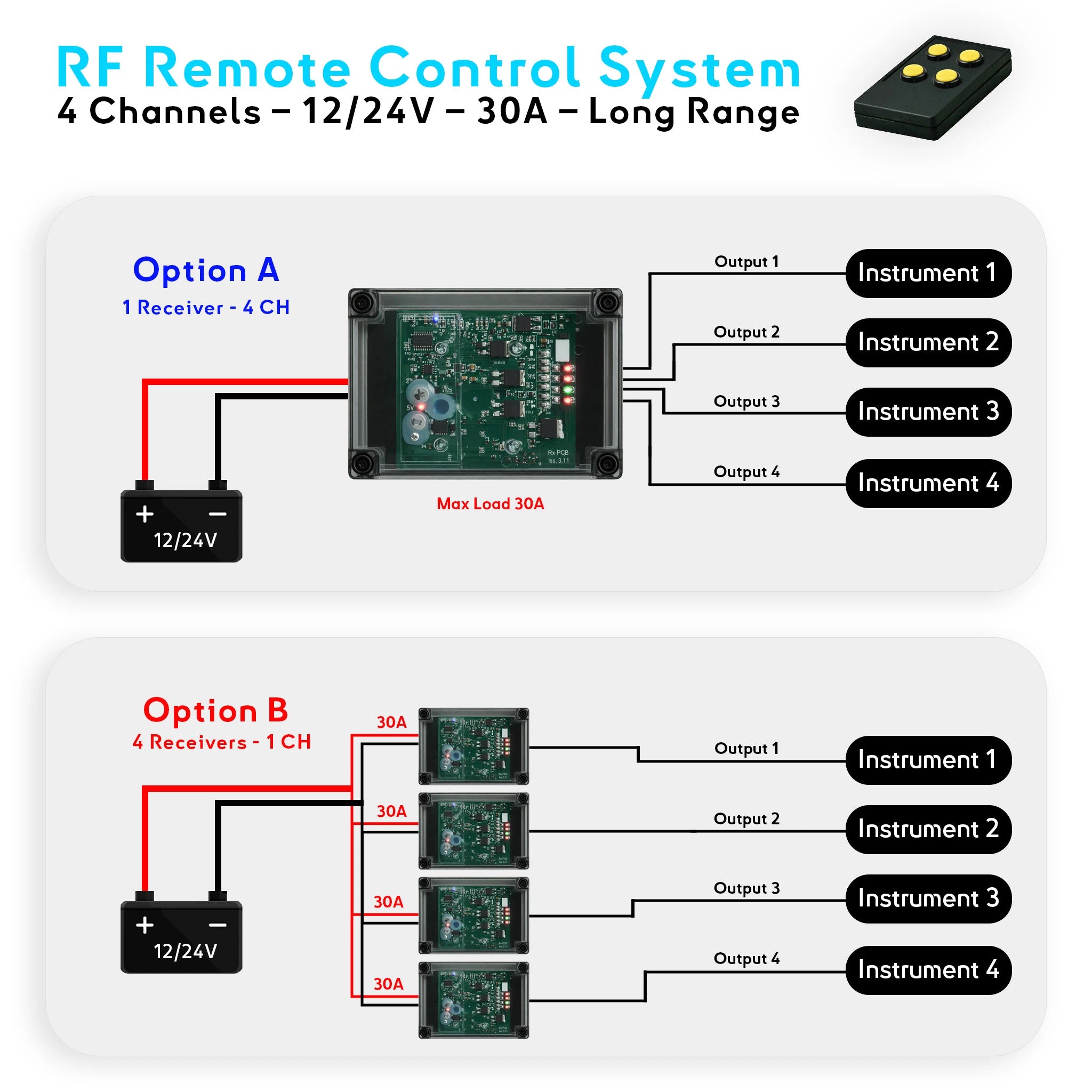
RF range depends on receiver location
The advertised RF range is measured under suitable conditions. Actual range on a boat depends on obstacles, receiver position, antenna orientation, structure and the condition of the transmitter batteries.
A receiver inside a heavily shielded enclosure or surrounded by metal will normally perform differently from one installed in a protected but less obstructed position.
Avoid unnecessary shielding
Do not choose a location simply because it is hidden. Consider what sits between the transmitter and receiver.
Keep it serviceable
You should still be able to reach the receiver for pairing, testing and electrical troubleshooting.
Test before closing panels
Check operation from the real intended control positions after the receiver is installed in its final location.
Typical uses for a boat wireless remote switch
Cockpit and deck lights
Turn lighting on before boarding or from another part of the boat.
Courtesy lights
Add another convenient control point without installing another long switch run.
Deck wash or livewell pump
Useful when the operator is working away from the helm.
Electric hatch or actuator
A momentary output can be useful when the equipment requires a momentary command.
Bilge pump manual command
An RF control point can supplement the manual circuit, but it should not replace correctly wired automatic bilge-pump operation.
Windlass or hoist command
Use the receiver to operate the appropriate control relay or contactor rather than carrying the main motor current.
Installation checklist
- Choose the receiver position. Keep it protected, accessible and reasonably close to the equipment it controls.
- Check the accessory current. Decide whether the receiver can switch it directly or whether another relay or contactor is required.
- Size the cable correctly. Consider load current, circuit length and acceptable voltage drop.
- Protect the positive feed. Use the appropriate fuse or circuit breaker for the cable and circuit.
- Select the correct channel mode. Use ON/OFF where a maintained output is required and momentary mode where the load needs only a temporary command.
- Test the RF range. Test from the actual operating positions with lockers and panels closed.
- Keep a physical fallback where appropriate. Important accessories should remain serviceable and controllable without depending unnecessarily on the handheld remote.
Remember: wireless control replaces part of the command wiring. It does not replace proper cable sizing, circuit protection, isolation or good terminals.
When RF control is not the right choice
A wireless remote is useful for many accessory circuits, but it should not automatically become the primary control method for every function.
Critical functions
Use an appropriate hard-wired control architecture where losing the wireless command could create an unacceptable risk.
High-current equipment
Do not exceed the receiver rating. Use a correctly sized contactor or control system when required.
Restricted wireless use
If vessel procedures or operating rules restrict radio-frequency controls, follow those requirements.
Wireless remote switch troubleshooting
| Symptom | Possible cause | What to check |
|---|---|---|
| Receiver does not respond | No receiver power, transmitter battery or pairing problem | Check receiver supply, transmitter batteries and synchronization |
| Range is inconsistent | Shielding, receiver position, weak transmitter batteries or obstacles | Test with the receiver temporarily repositioned |
| Receiver switches but accessory does not | No load supply, blown fuse, incorrect output wiring or missing negative | Check the protected feed, output and accessory negative connection |
| Fuse blows | Short circuit, incorrect wiring or excessive load current | Disconnect the load and test the circuit in sections |
| Receiver output is overloaded | Accessory current exceeds the appropriate direct-switching load | Use the receiver to command a correctly sized relay or contactor |
Frequently asked questions
Does an RF remote reduce the amount of wiring on a boat?
It can. Installing the receiver near the accessory can remove the need to run a separate control cable all the way back to the helm or another switch position.
Can I keep the existing switch and add a wireless remote?
Yes, depending on the circuit design. In many installations the RF control is most useful as an additional control point rather than a replacement for every physical switch.
Can the Baywatt receiver switch a 30A load directly?
The receiver is rated up to 30A per channel, but direct switching still depends on the actual load characteristics, cable size, circuit protection and equipment requirements. Loads with high starting current may require a separate relay or contactor.
Can I control a windlass or thruster directly from the RF receiver?
The receiver should be used as a control signal for the correctly sized windlass or thruster contactor rather than carrying the main motor current.
Does the Baywatt wireless remote need Wi-Fi or Bluetooth?
No. The system uses 868 MHz RF communication directly between the handheld transmitter and receiver.
Use wireless control where it simplifies the installation
An RF remote is most useful when it solves a real wiring problem: adding another control point, simplifying a refit or keeping control wiring local to equipment installed far from the helm.
Check the current first, protect the circuit correctly and use a separate relay or contactor for heavy loads. For important functions, keep a practical physical control or fallback where appropriate.


