

Wireless Remote Switch - 4CH, 12/24V 30A - Long Range (on demand)
SKU:
WK4CH-1
- 550.00€
- 550.00€
- Unit price
- per
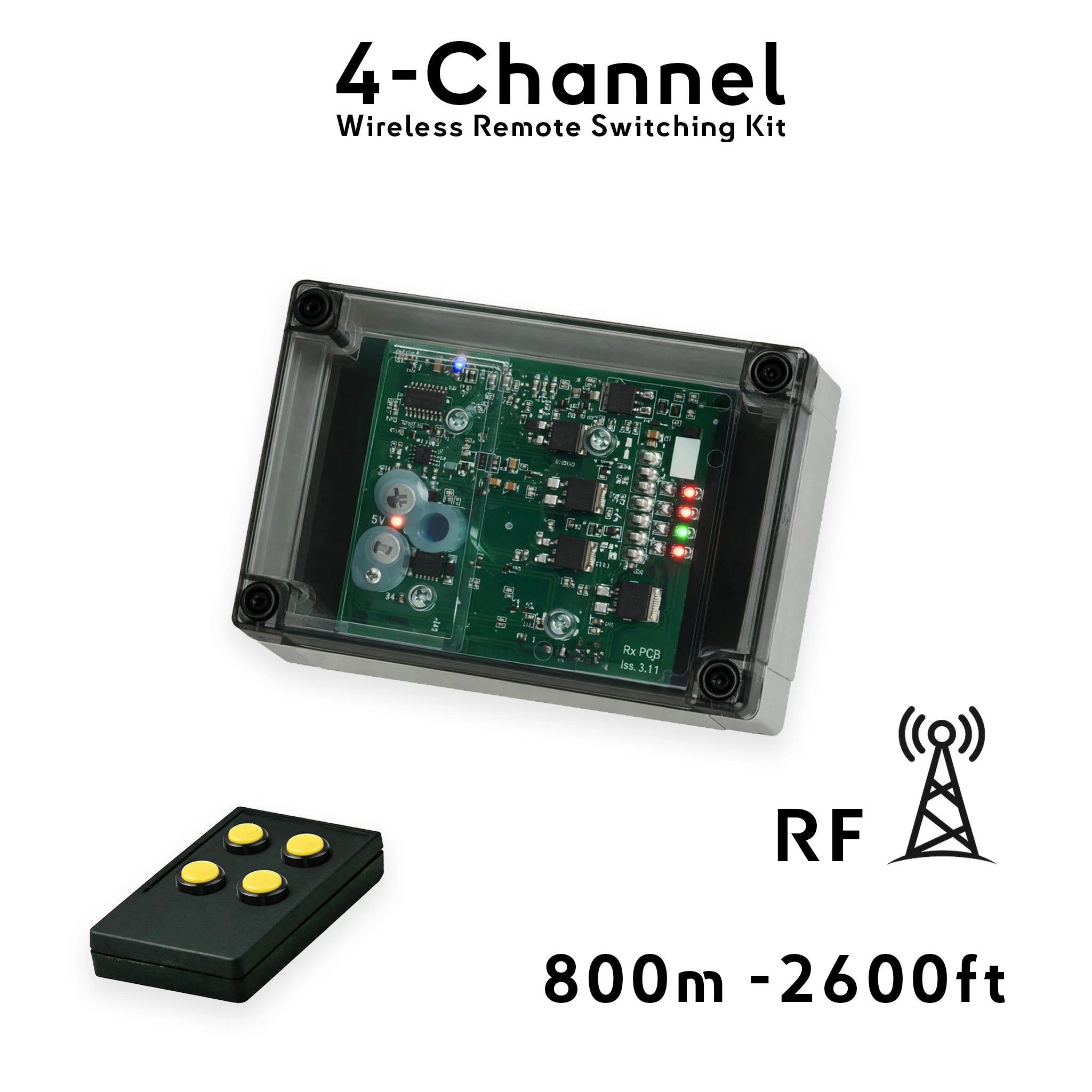
Boat Wireless Remote Switch Kit – 4CH – 12/24V – 30A – Long Range
12/24V • 868 MHz RF • Up to 2600ft (800m)
Availability: Product on demand : ~20 days before dispatch.
Wireless remote switching (less wiring to pull)
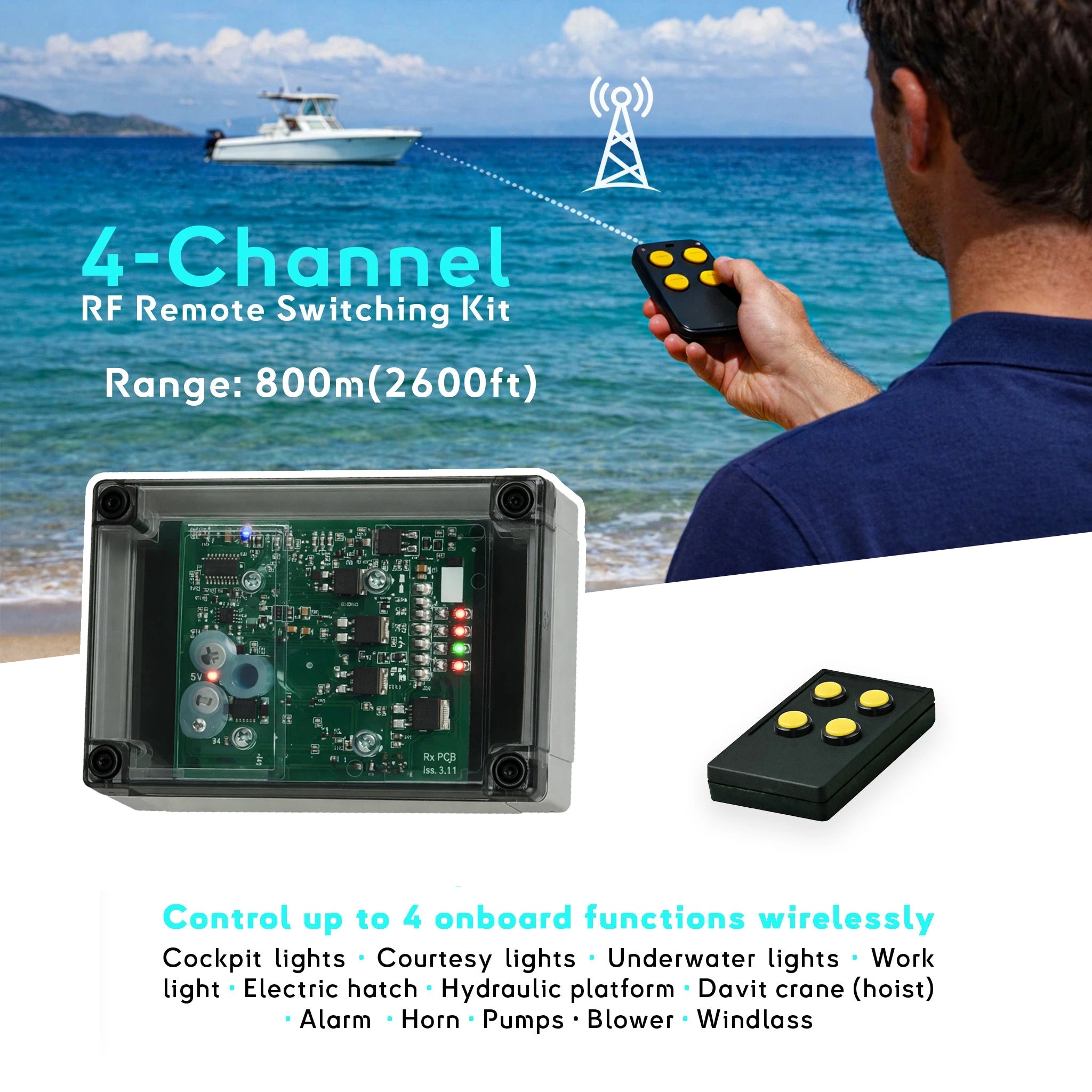
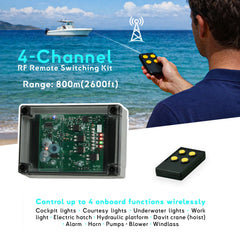
This 4-channel kit lets you switch onboard 12/24V circuits by handheld remote. The key advantage onboard is simple: receivers mount close to the lights/pumps/accessories, so you keep wiring local (short power + short output runs) instead of pulling long switch/control cables back to the helm.
Result: cleaner harness routing, quicker refits, and easier access for troubleshooting.
Less cable across the boat
Traditional helm panels often need a dedicated control wire (or multi-core harness) per function. On larger boats—or refits with already packed routes—this adds time, copper, and weight.
Shorter cable runs: fewer long control wires routed across the boat
Less copper to pull: fewer conductors through tight chases and consoles
Lower harness weight: less cable mass over long distances
Faster diagnostics: receivers are located near the actual load
Long-range RF control (no app, no Wi-Fi)
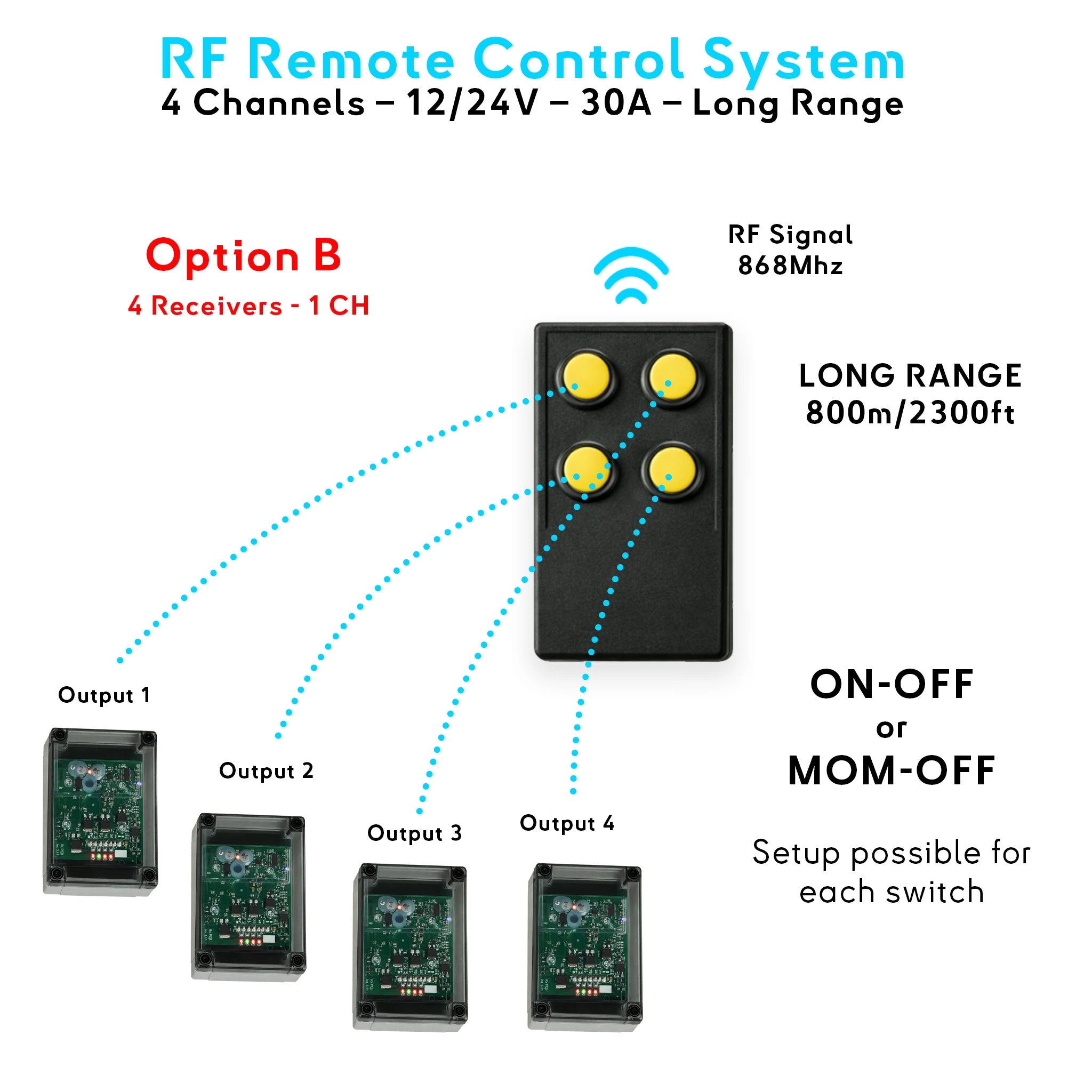
Operation is based on 868 MHz RF (not Wi-Fi and not Bluetooth). That means no phone app, no router, and no dependency on onboard networks.
No Wi-Fi dependency: nothing to configure with onboard internet/network hardware
Direct command path: remote talks straight to the receiver(s)
Extended range: up to 2600ft (800m) advertised range (installation and environment dependent)
Note: range depends on antenna position, obstacles, onboard structure, and installation environment.
4 channels, each configurable
Each channel can be set independently depending on the function:
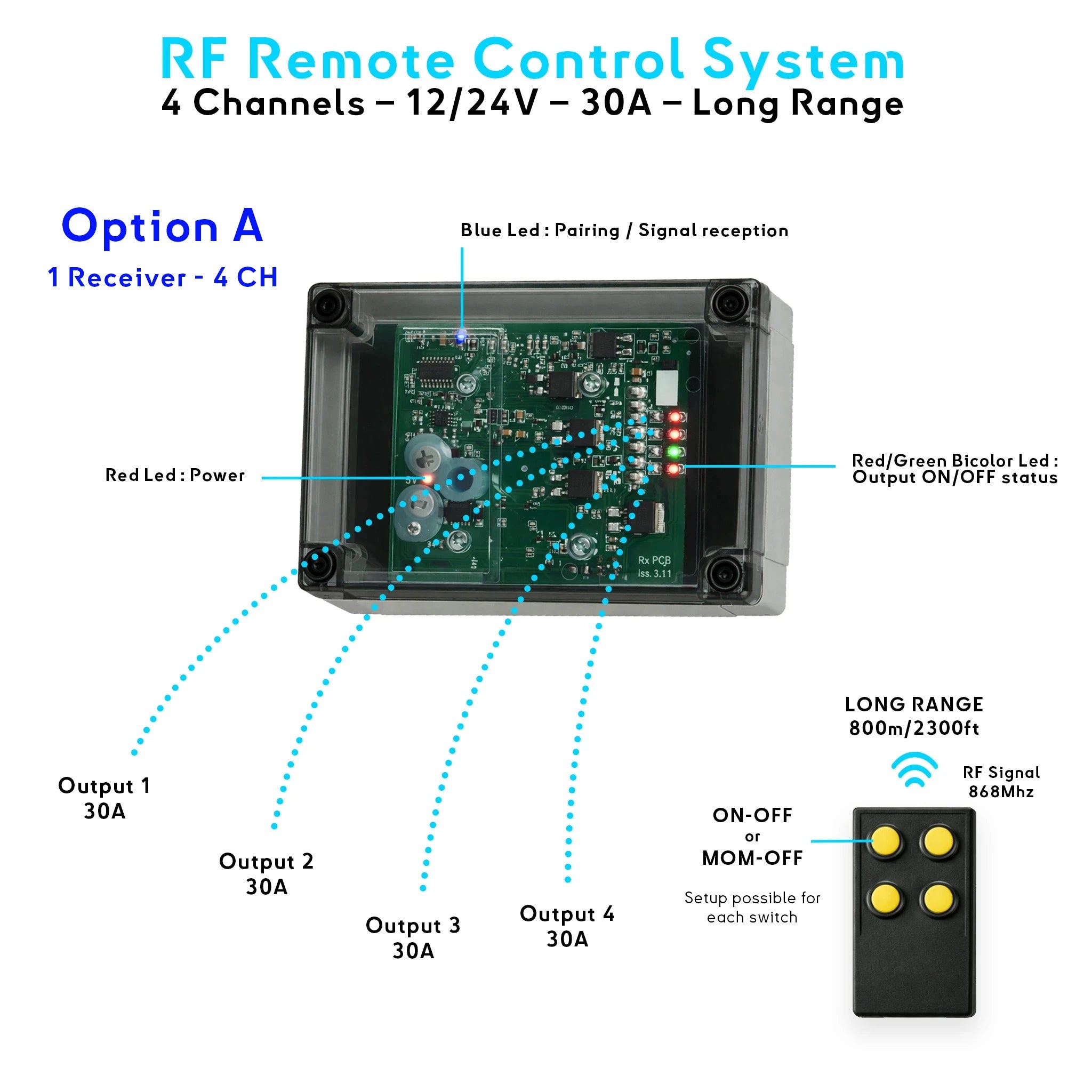
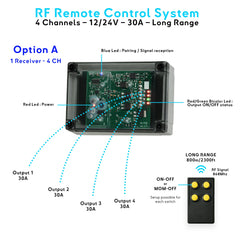
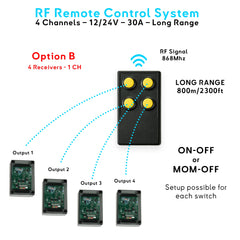
ON / OFF (latching) – suits lighting and accessories
MOM / OFF (momentary) – suits actuators and "pulse command" functions
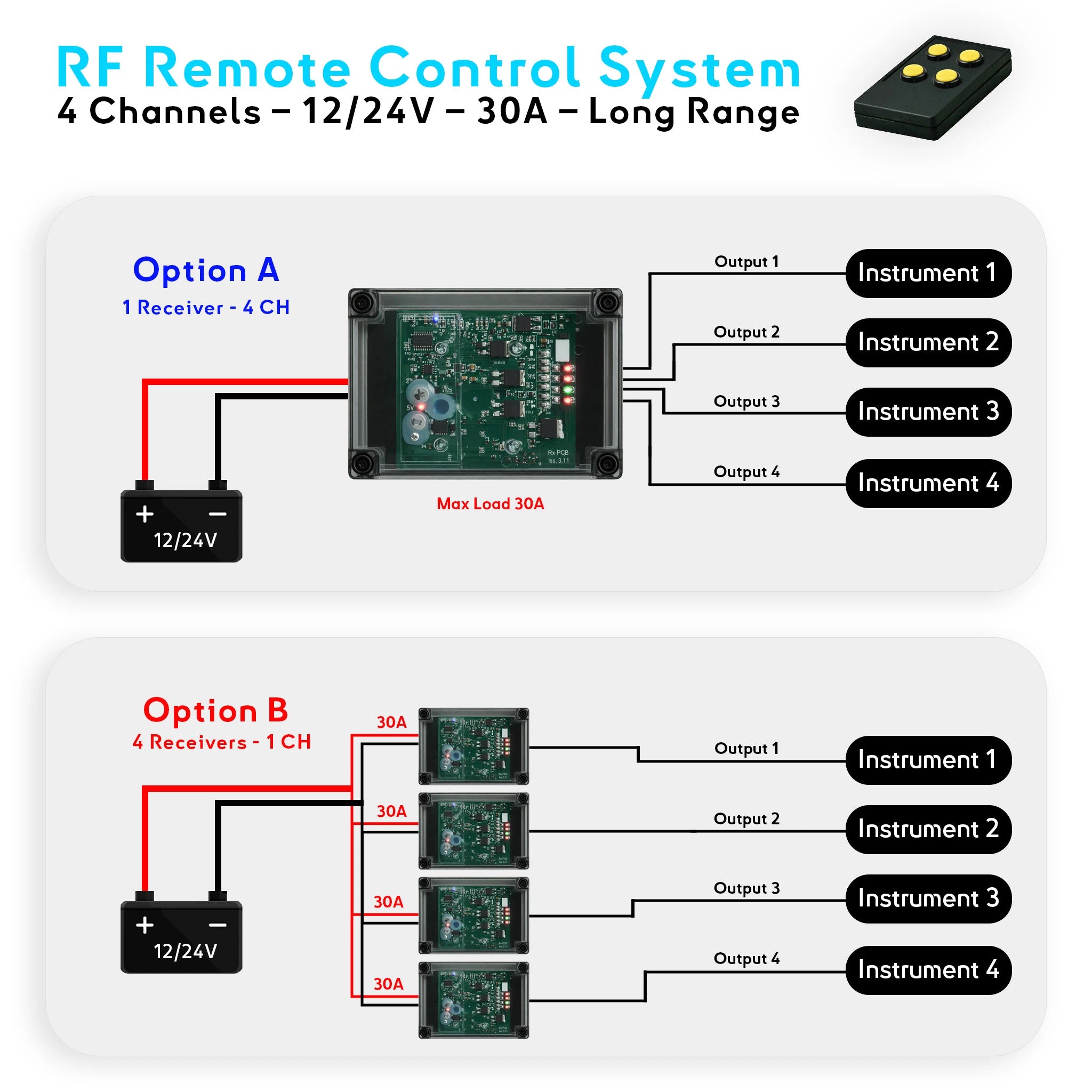
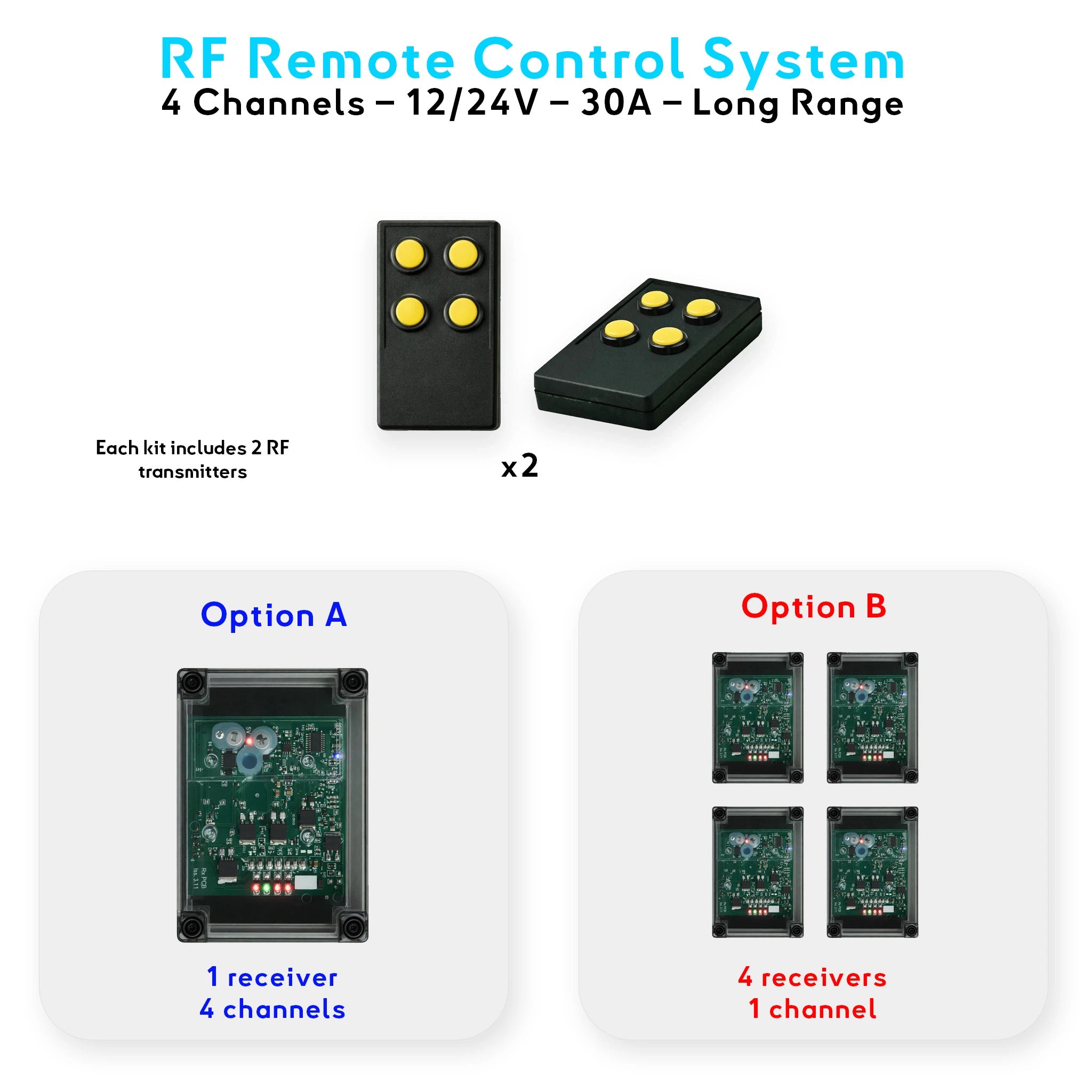
Choose your configuration: Option A vs Option B
Two installation layouts are available depending on your wiring strategy and how spread out your loads are onboard.
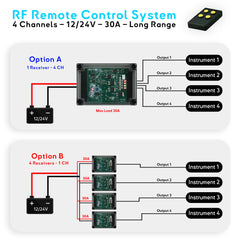
| Option A – 1 receiver, 4 channels | Option B – 4 receivers, 1 channel each |
|---|---|
|
Best for: centralized installation, short runs to loads, clean single mounting point. How it works: one multi-output receiver handles all 4 outputs from one enclosure. Wiring benefit: simple architecture (one receiver + 4 output cables). |
Best for: refits and large boats where loads are far apart (lights/pumps/hatches in different zones). How it works: one dedicated receiver per function, mounted close to each load. Wiring benefit: shorter output runs near the load (often easier routing and troubleshooting). |
|
Typical use case: helm/console area controls multiple nearby circuits (deck lights, courtesy lights, etc.). Note: keep the receiver in a protected, accessible location for service. |
Typical use case: one receiver in the aft locker (pump), one in the T-top (lights), one near a windlass relay, etc. Note: each receiver still respects the 30A max rating; use a relay/contactor for heavy loads. |
Both options: each channel can be configured as ON/OFF (latching) or MOM/OFF (momentary), depending on the function.
Typical onboard uses
| • Cockpit & deck lights | • Bilge pump manual override | • Electric hatch / actuator (momentary) |
| • Courtesy lights | • Deck wash / livewell pumps | • Hydraulic platform (momentary) |
| • Underwater lights | • Ventilation blowers | • Davit / hoist control |
| • Work / spreader / rear flood lights | • Alarm / siren / strobe | • Windlass / thruster control via relay or contactor |
30A per receiver (use a contactor for heavy loads)
Each receiver is rated up to 30A at 12/24V, which covers many onboard accessories directly. For high-current equipment (windlass, thrusters, heavy hydraulic packs), use the receiver as a control signal to trigger a correctly sized relay or contactor.
LED status feedback (quick checks)
LEDs are visible through the receiver enclosure:
Red LED: system power
Blue LED: pairing / RF reception
Red/Green LEDs: output ON/OFF status per channel
Quick Sync (one-time setup)
Synchronize is typically done once during installation. After that, daily use is immediate from the handheld remotes.
Optional fixed control panel
A fixed helm/wall control solution can be added in addition to handheld remotes (project dependent). Contact: contact@baywatt.com
What's in the box
Common to all kits:
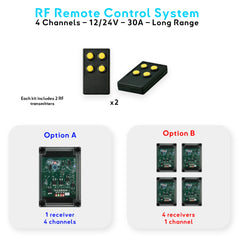
2 × handheld RF transmitters
Option A – 1 receiver / 4 channels:
1 × 4-channel receiver (central unit)
Option B – 4 receivers / 1 channel each:
4 × 1-channel receivers (one receiver per function)
Quick technology comparison (control method)
| Control method | Typical behavior | Dependency | Installation |
|---|---|---|---|
| 868 MHz RF (this kit) | Immediate press-to-switch, dedicated remote | Standalone (no phone / no router) | Receivers near loads → less control wiring to pull |
| Wi-Fi switching | Can vary with signal/network load | Router / network stability | Network setup + coverage planning |
| Bluetooth control | Shorter range; pairing/connect states possible | Often phone/app behavior | Simple wiring, but limited by range |
| NMEA 2000 switching | Network-based control via MFD/controls | NMEA backbone + compatible integration | More wiring + configuration/integration steps |
FAQ: Signal interference
| Technology | Impact | Note |
|---|---|---|
| Wi-Fi / Bluetooth | None | Different band (2.4 GHz vs 868 MHz) |
| VHF radio | Negligible | Different band (~156 MHz vs 868 MHz) |
| GPS / AIS | None | Different bands (GPS ~1575 MHz; AIS near VHF) |
Technical Specifications
| Specification | Value |
|---|---|
| System voltage | 12 / 24 V DC |
| Frequency8 | 868 MHz RF |
| Channels | 4 |
| Receiver rating | Up to 30A per channel |
| Channel modes | ON/OFF or MOM/OFF (per channel) |
| Range | Up to 800 m (~2600ft) (depending on conditions) |
| Controller protection | IP66 / IP67 |
| Controller dimensions | 130 × 80 × 35 mm |
| Transmitter power | 2 × AA 1.5 V |
| Transmitter dimensions | 120 × 65 × 22 mm |
Our Recommendations


Marine Toggle Switch Panel - Dual Color Indicators (Red/Green) Splashproof
- From 22.00€
- From 22.00€
- Unit price
- per


12mm RGB Indicator Light – 12/24V, SS316, Waterproof IP67
- 7.90€
- 7.90€
- Unit price
- per


12V RGB Push Button Switch 22mm Vandal-Proof IP67
- 16.00€
- 16.00€
- Unit price
- per


8mm RGB Indicator Light – 12/24V, SS316, Waterproof IP67
- 6.90€
- 6.90€
- Unit price
- per
- Choosing a selection results in a full page refresh.


