
The best location is close to the battery bank, typically on a nearby bulkhead, mounting plate, or the side wall of the battery compartment. Keeping the switch near the main battery helps keep high-current cable runs short and makes emergency isolation easy to reach. Avoid leaving the switch loose or mounting it directly on the battery case unless the installation is specifically designed for that.

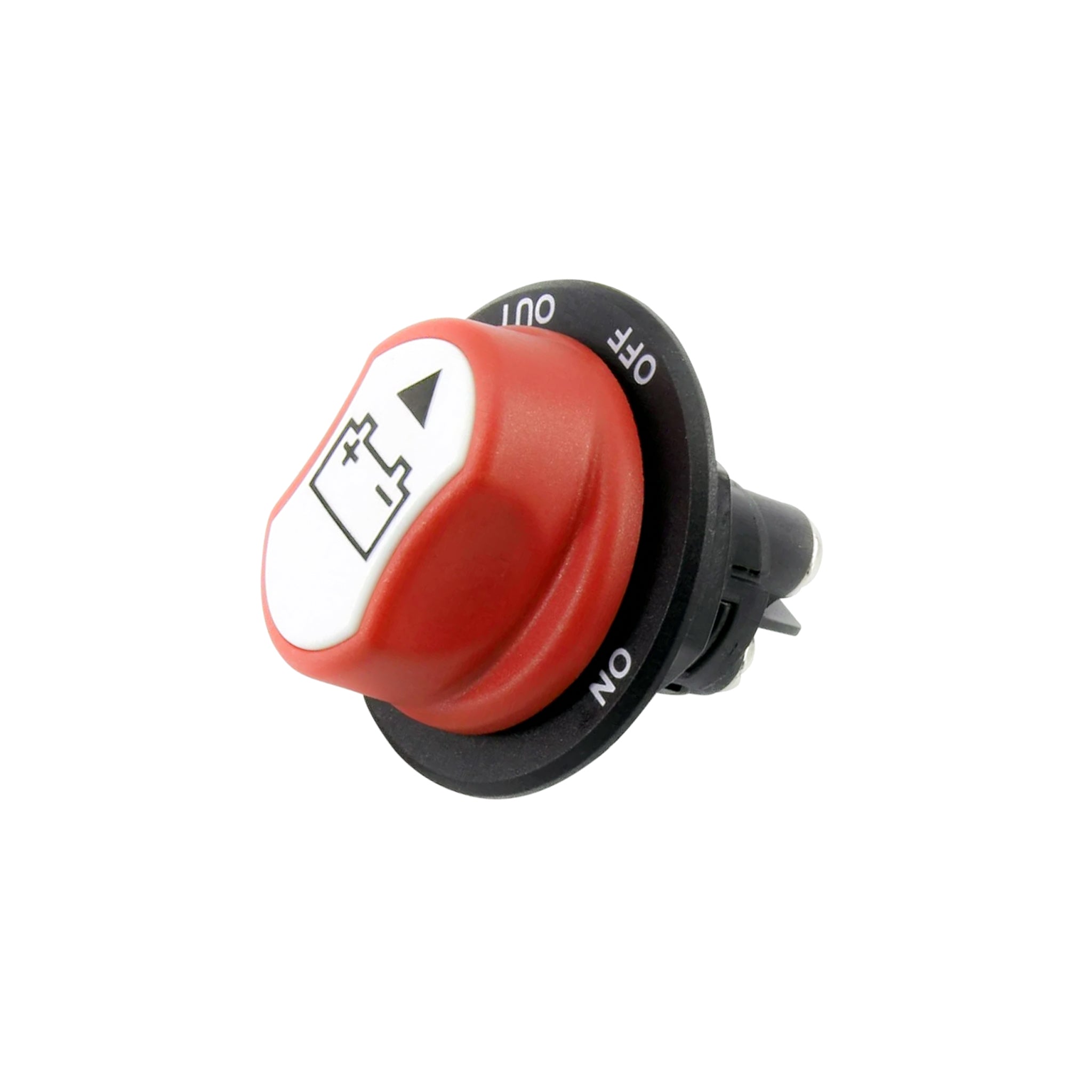
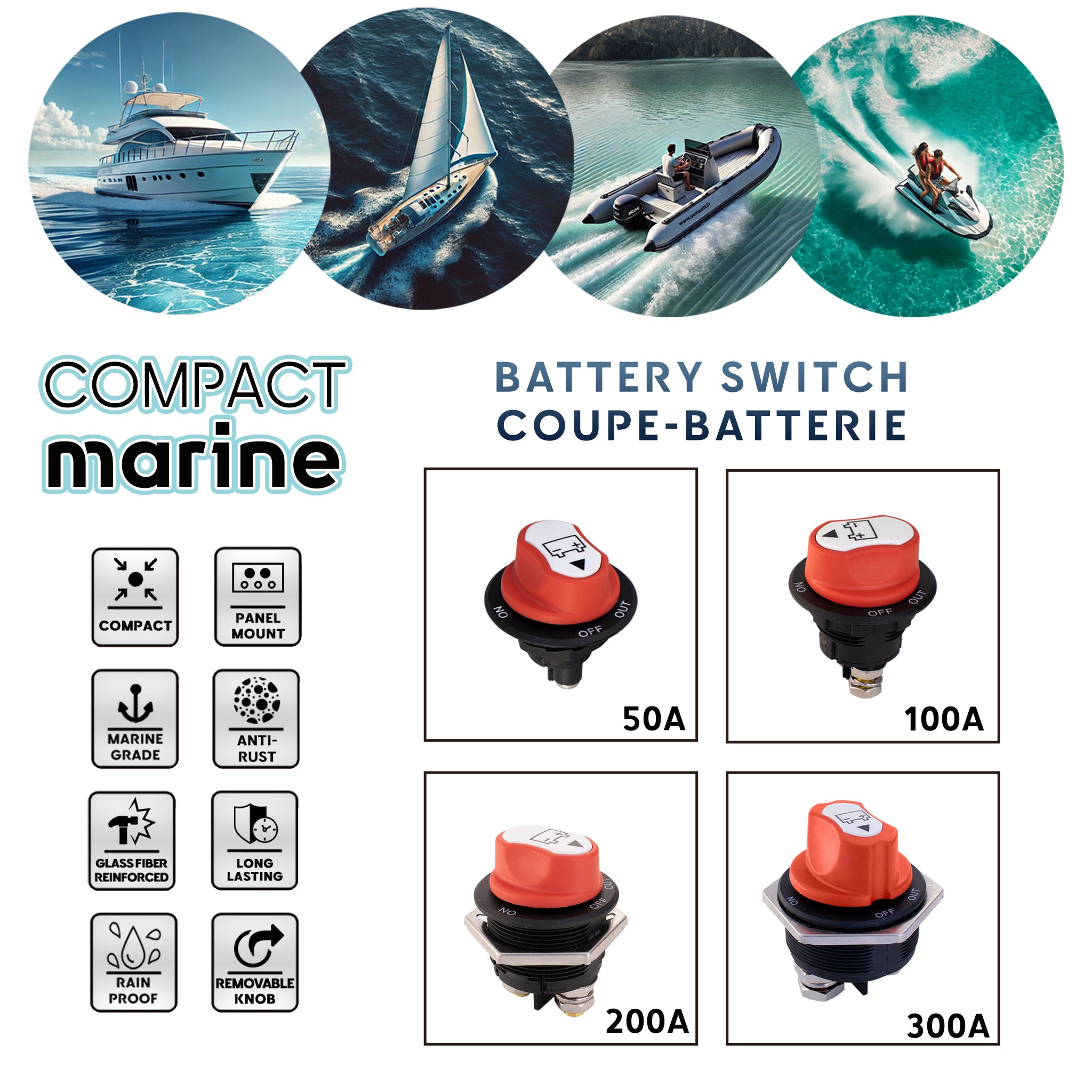
Compact Battery Switch 50A / 100A / 200A / 300A
SKU:
BD50
- 8.50€
- 8.50€
- Unit price
- per
Compact Battery Switch — 50A / 100A / 200A / 300A
50A to 300A
12/24V Systems
Up to 50V DC
IP54 / IP56
Nickel-Plated Brass
Removable Knob
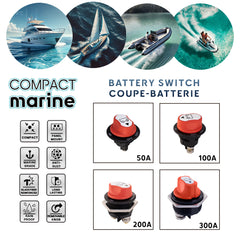
Compact marine battery isolation without giving up current capacity. Our rotary battery switches are available in 50A, 100A, 200A and 300A versions for yachts, sailboats, tenders, jet skis and other onboard DC systems. The small footprint makes them especially useful where a conventional battery switch is simply too bulky.
One compact switch family, four current ratings. Choose the version according to the maximum current of your installation, cable size and battery system requirements. The switch provides battery isolation; it does not replace the correctly sized fuse or circuit breaker required to protect the cable.
Which Model Should I Choose?
The four models share the same compact rotary concept, but their current capacity, terminal size and protection level differ. The guide below gives a practical starting point before checking the actual current demand of your installation.
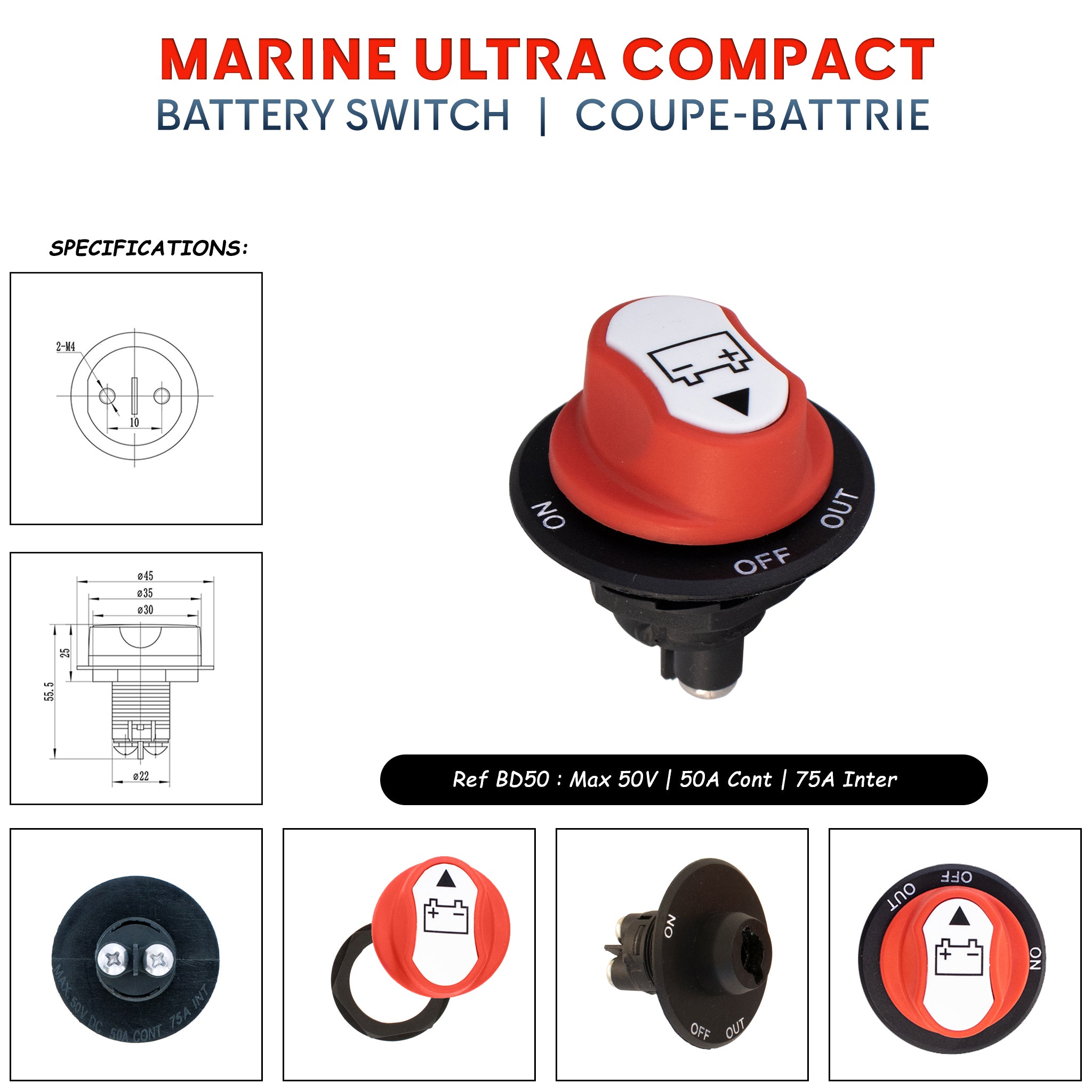
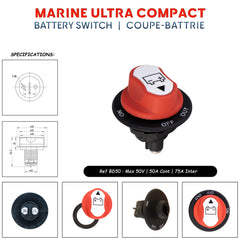
BD50 — 50A
50A continuous · 75A intermittent · 300A / 5s
The smallest option for compact auxiliary circuits, tenders, jet skis and low-current battery isolation where installation space is limited.
Max voltage: 50V DC · Protection: IP54 · Stud: M4
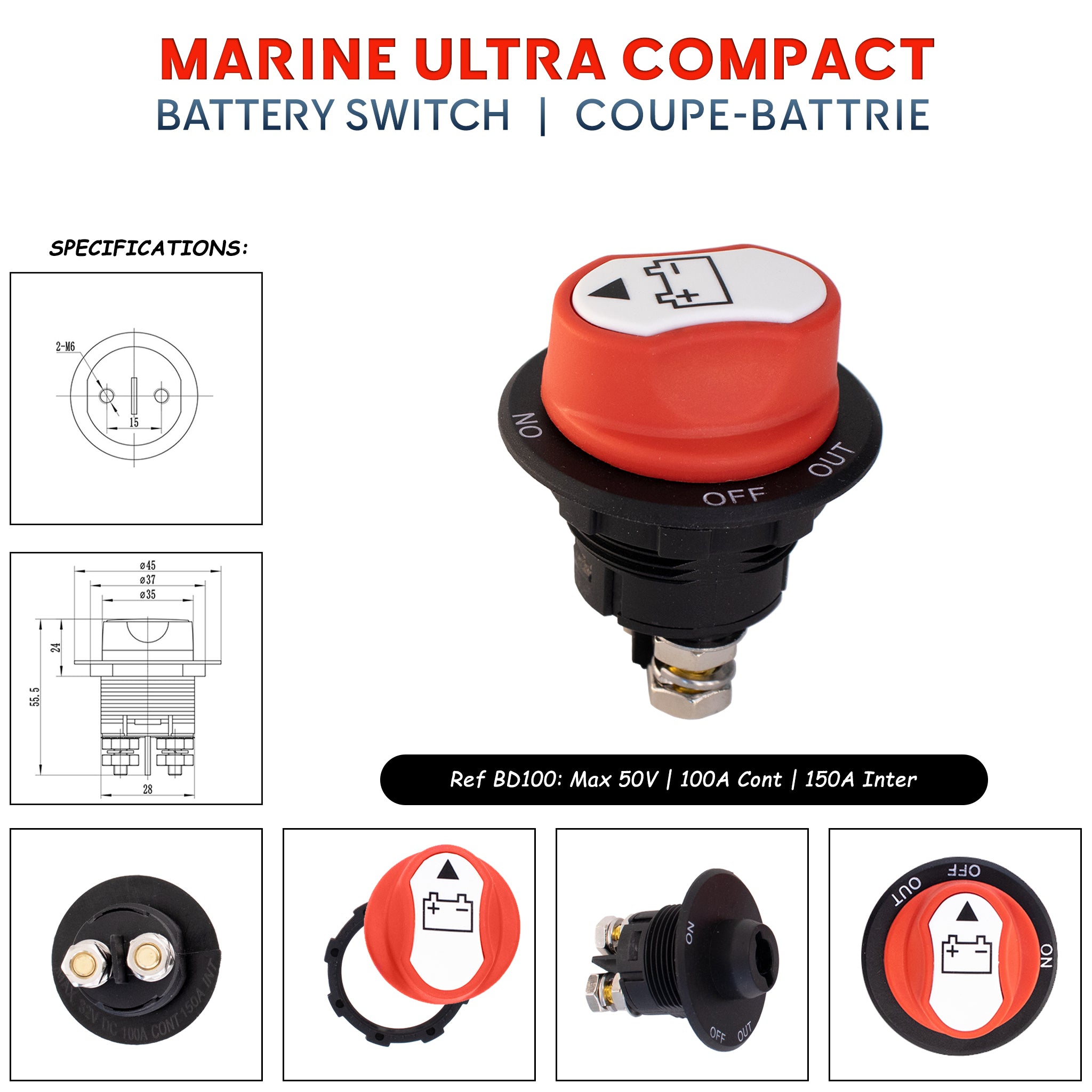
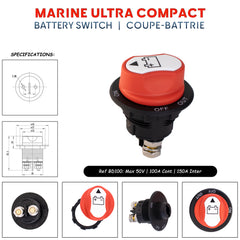
BD100 — 100A
100A continuous · 150A intermittent · 500A / 5s
A versatile step up for auxiliary battery banks and small 12/24V marine installations that need more current capacity while keeping the switch very compact.
Max voltage: 32V DC · Protection: IP54 · Stud: M6
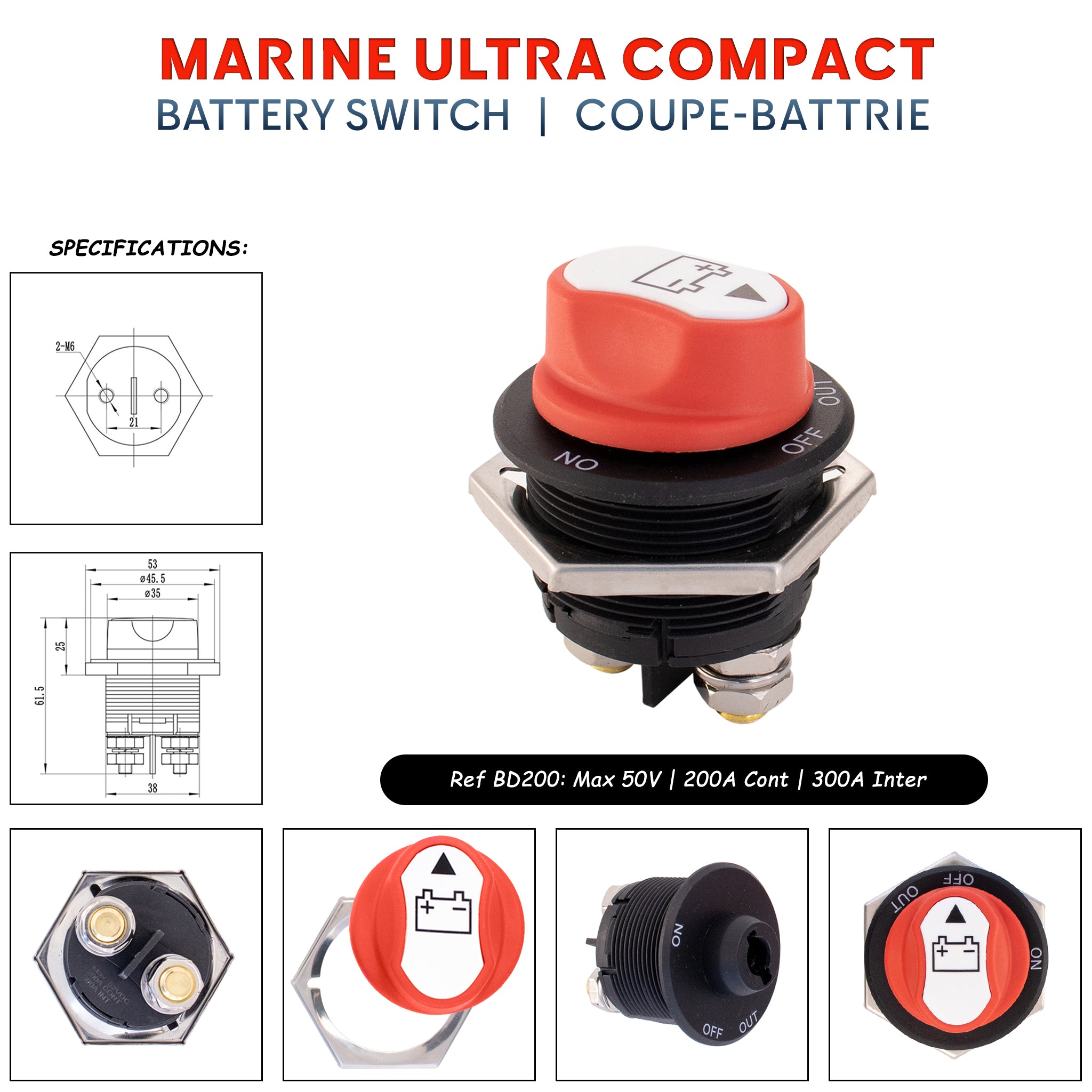
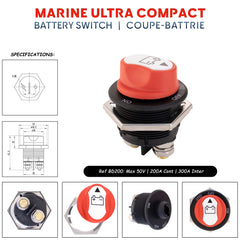
BD200 — 200A
200A continuous · 300A intermittent · 1000A / 5s
Designed for higher-current battery isolation on sailboats and motorboats, with larger M8 terminals and improved IP56 protection.
Max voltage: 32V DC · Protection: IP56 · Stud: M8
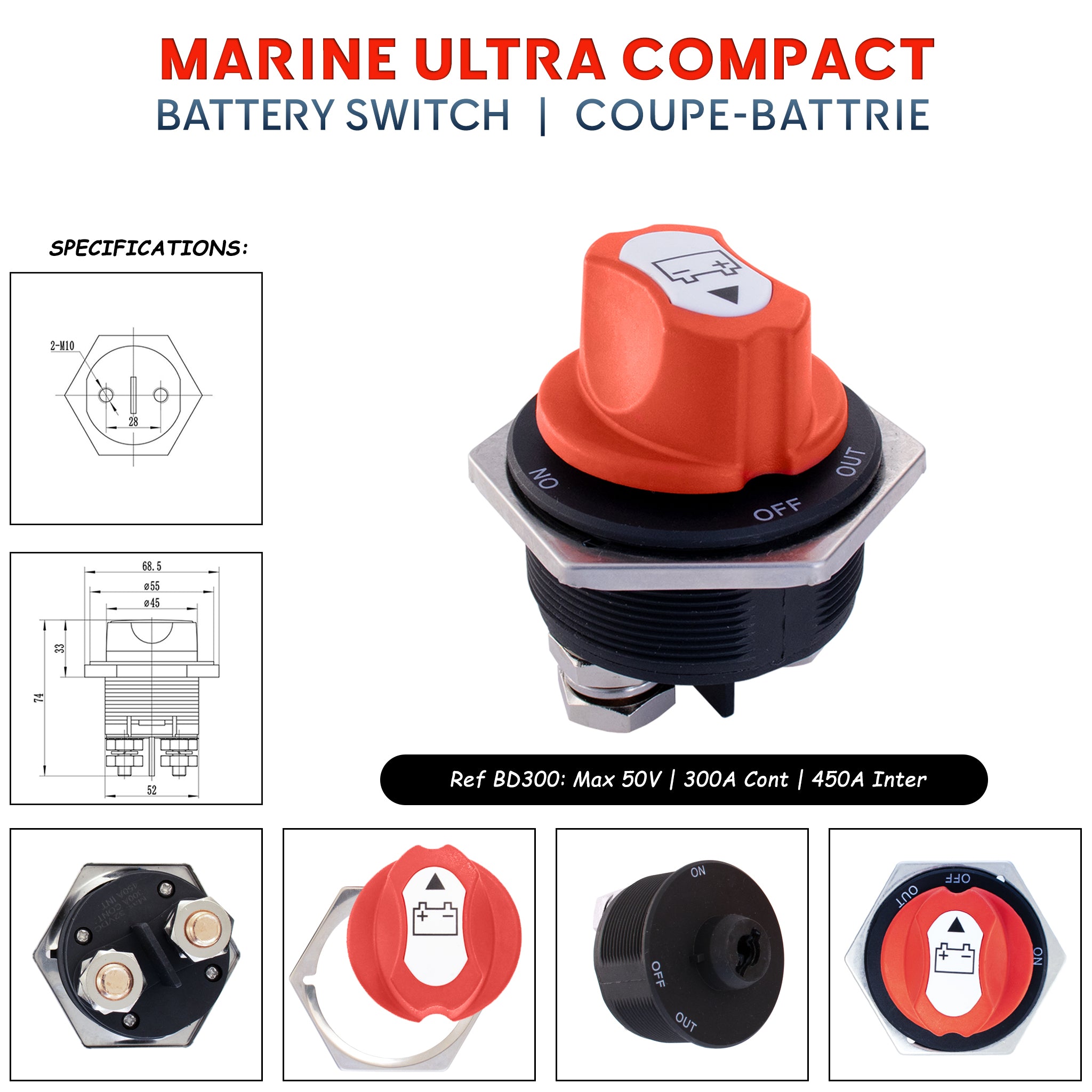
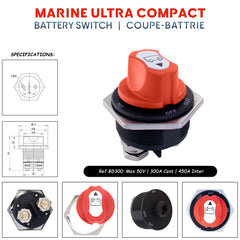
BD300 — 300A
300A continuous · 450A intermittent · 1000A / 5s
The highest-current version for larger battery banks and demanding DC installations where a compact master disconnect is still required.
Max voltage: 32V DC · Protection: IP56 · Stud: M8
Why a Compact Battery Switch Makes Sense Onboard
Space-saving installation
The super-compact rotary body fits into crowded battery compartments, electrical cabinets, control panels and bulkheads where a larger marine isolator would be difficult to mount.
Removable rotary knob
OFF–ON–OUT operation allows normal isolation and reconnection, while the removable knob can help prevent accidental operation when the circuit is intentionally left isolated.
Nickel-plated brass terminals
Corrosion-resistant conductive hardware is better suited to humid and salt-air environments than untreated connections and supports a durable marine installation.
Marine-oriented protection
BD50 and BD100 are rated IP54; BD200 and BD300 are rated IP56, giving the larger models increased protection against water exposure.
OFF – ON – OUT Operation
OFF
Battery circuit isolated. Use this position for shutdown, servicing or storage according to your boat's electrical procedure.
ON
Battery circuit connected for normal operation. Always keep the installation within the switch, cable and protection-device ratings.
OUT
Knob-removal position. Useful when you want the battery circuit to remain intentionally isolated and reduce the risk of accidental reconnection.
Typical Marine Installations
Sailboats & Yachts
Compact main or auxiliary battery isolation where electrical-panel and locker space is valuable.
Tenders & RIBs
A practical master disconnect for smaller DC systems without installing an oversized traditional selector switch.
Jet Skis & Small Craft
Useful where vibration, humidity and very limited mounting space make a compact removable-knob switch attractive.
Auxiliary Battery Banks
Isolate dedicated house, electronics or accessory circuits independently from the rest of the onboard electrical system.
Build a Clean, Reliable Installation
Good connections matter as much as the switch. Use correctly sized marine cable, properly crimped terminals and heat-shrink protection. For a professional installation, add our tin-plated terminal kit, pair it with our crimping tool (6–50 mm²), and protect cable ends with 3:1 adhesive heat-shrink sleeves.
Installation note: Select the battery switch from the real continuous and peak current of the system—not only from battery capacity. Cable cross-section, cable length, fuse/breaker rating and connection quality must also be suitable for the installation.
Building or upgrading your DC distribution system?
Explore busbars, fuse blocks and other marine power-distribution components.
Compact Battery Switch — Technical Specifications
BD50
BD100
BD200
BD300
OFF–ON–OUT
| Specification | BD50 | BD100 | BD200 | BD300 |
|---|---|---|---|---|
| Voltage Rating | Max 50V DC | Max 32V DC | Max 32V DC | Max 32V DC |
| Continuous | 50A | 100A | 200A | 300A |
| Intermittent | 75A | 150A | 300A | 450A |
| Cranking (5s) | 300A | 500A | 1000A | 1000A |
| Operation | 2P SPST OFF–ON–OUT | 2P SPST OFF–ON–OUT | 2P SPST OFF–ON–OUT | 2P SPST OFF–ON–OUT |
| Protection | IP54 | IP54 | IP56 | IP56 |
| Termination Stud | M4 × P0.7 | M6 × P1.0 | M8 × P1.0 | M8 × P1.25 |
Before installation: confirm that the selected model is suitable for the system voltage, continuous current and short-duration peak current. Install appropriate cable protection close to the battery according to the electrical design of the vessel.
How to use :
Link to the blog
Discover tips, tricks, and detailed instructions on using our product in our dedicated blog post. Learn about setup, operation, and optimization to get the most out of your purchase.
Link to the blog
Frequently Asked Question
Our Recommendations


Battery Isolator Switch - 12V 150A with Auxiliaries
- 9.00€
- 9.00€
- Unit price
- per


Bilge Pump Control Panel with Buzzer Alarm
- 19.20€
- 19.20€
- Unit price
- per


Crimping tool for heat shrink terminals
- 17.50€
- 17.50€
- Unit price
- per


Crimping pliers for cable ferrules
- 22.00€
- 22.00€
- Unit price
- per


Crimp tool for tin-plated terminals 6-50mm²
- 34.50€
- 34.50€
- Unit price
- per
- Choosing a selection results in a full page refresh.


