
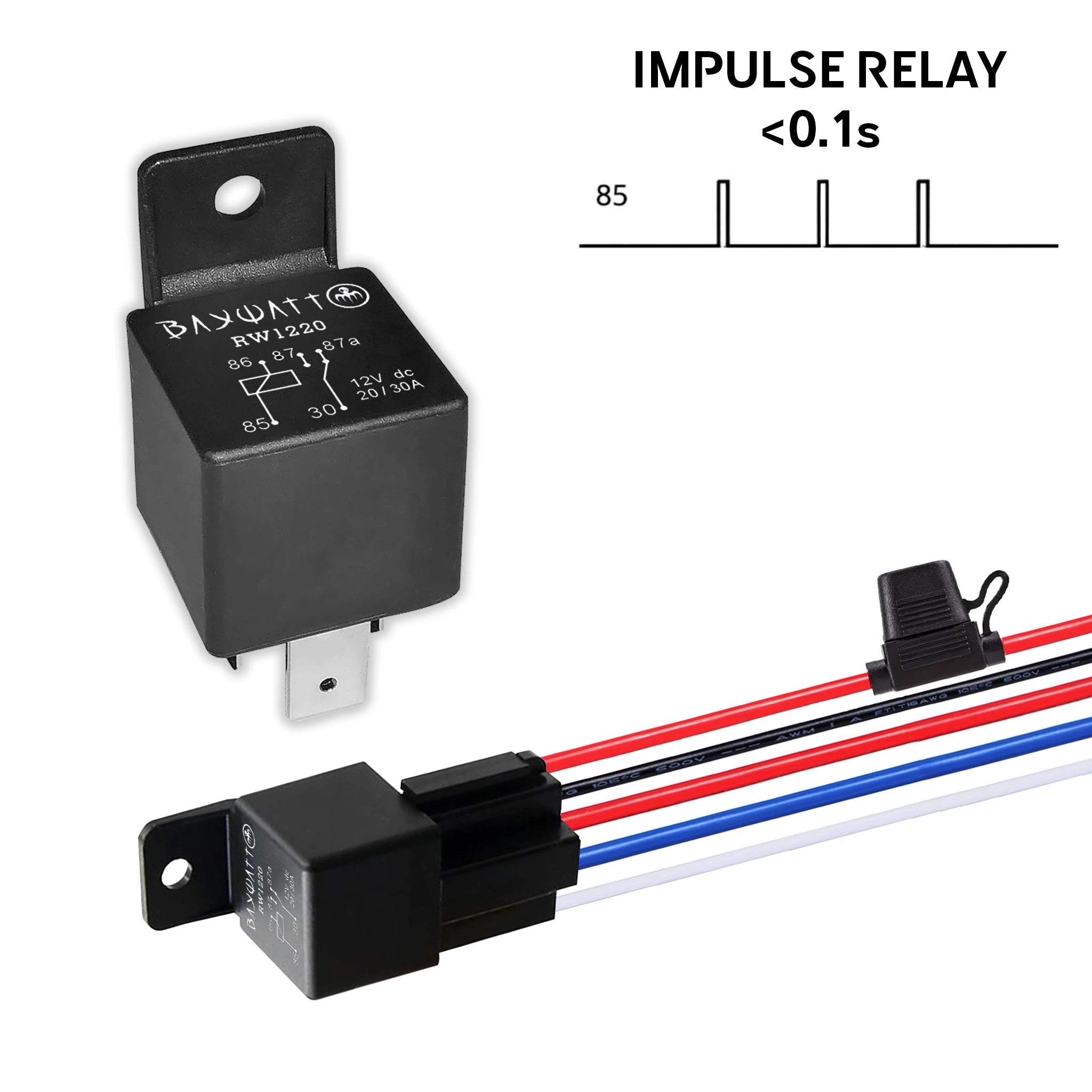


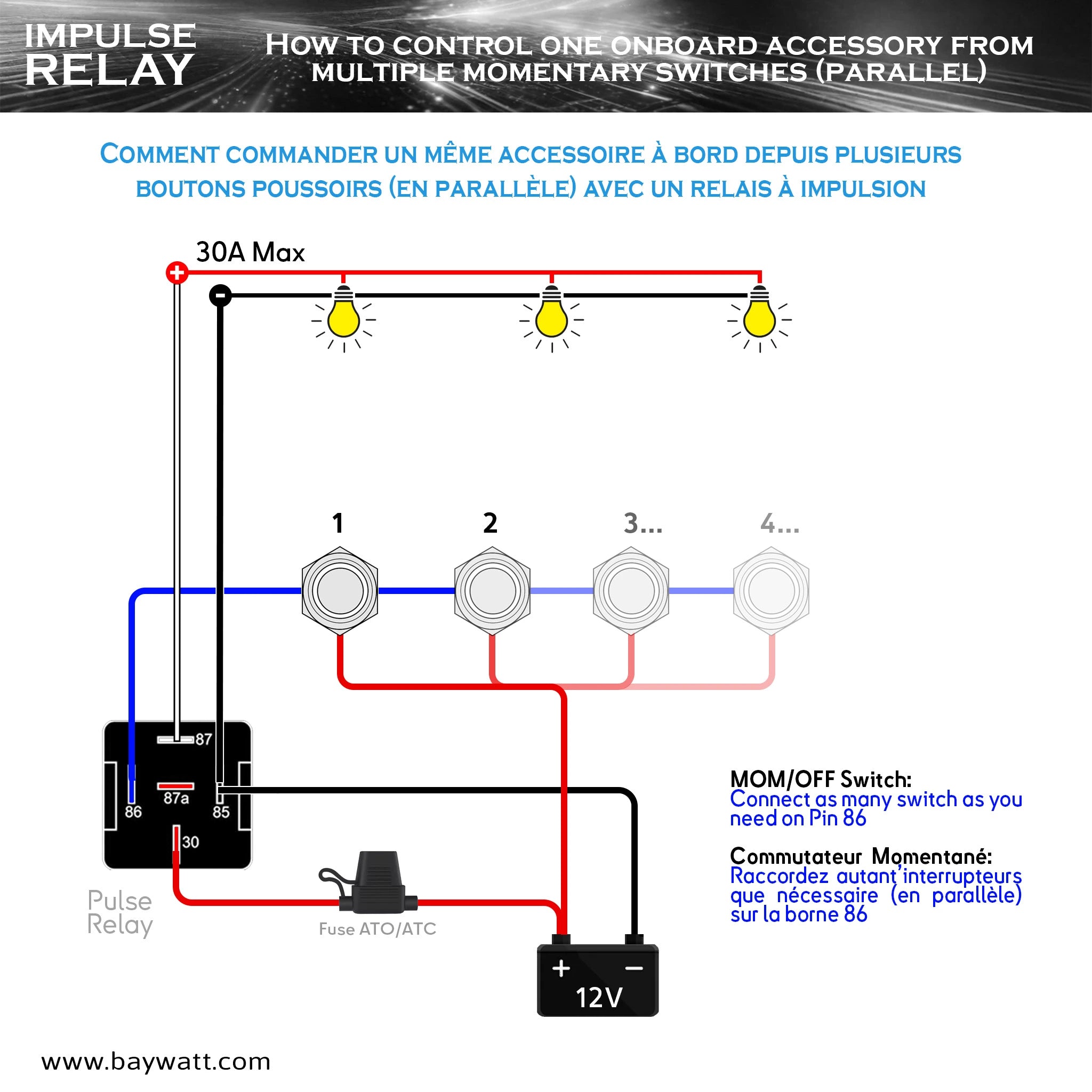


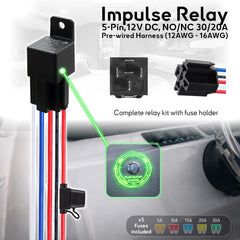


A 12V impulse relay lets you control the same accessory from several momentary push buttons. The first press turns the circuit ON, the second press turns it OFF. It works like a domestic stairway relay, but adapted to 12V/24V DC systems such as boats, vans, RVs and 4x4 installations.

Toggle Relay / Impulse Relay / Push Button Relay (Flip-Flop Relay)
A Toggle Relay—also known as an Impulse Relay, Push Button Relay, Flip-Flop Relay, Stepping Relay or Latching Relay—is a specific type of relay designed to switch one load ON/OFF from two or more momentary push buttons wired in parallel.
Each press sends a short pulse to the control input: 1st press → ON, 2nd press → OFF, 3rd press → ON… and so on. This is the same operating logic as a household stairway impulse relay (télérupteur), adapted to 12V/24V DC systems and marine/automotive wiring standards.
Why use a Toggle Relay onboard?
It enables clean multi-location control of a single circuit without routing high load current through multiple switches. Only a low-current control signal goes to the push buttons, while the relay contacts handle the load.
Typical onboard applications
- Cockpit light: switch it when boarding and when leaving the boat
- Cabin lights: entry point + bedside (berth) + central control panel (often near the chart table)
- Modern layouts: add extra control at helm starboard and helm port while keeping a master control
Recommended wiring (simple and scalable)
For a multi-button installation, a 3–4 core cable is typically ideal:
- +12V / +24V permanent (control feed)
- 0V / Ground (return)
- Control signal (pulse to the relay control input)
- Optional: LED feedback (indicator state wire)
LED feedback (optional, recommended)
If your push buttons include an LED indicator, a dedicated feedback wire lets each button display the real circuit state: LED ON when the load is ON, LED OFF when the load is OFF. A common approach is to drive the LED from the relay’s switched output so the indicator always matches the actual accessory state.
Notes
- Designed for momentary push buttons (wired in parallel)
- No programming required (no controller, no app)
- Relay contacts provide ON/OFF toggling (flip-flop function)
Technical Specifications
| Type | Impulse Relay / Toggle Relay / Latching Relay |
| Nominal Voltage | 12V DC |
| Contact Configuration | 5-Pin Changeover (SPDT) |
| Contact Rating | 30A (NO – Terminal 87) / 20A (NC – Terminal 87a) |
| Control Input | Impulse control via momentary push button (parallel wiring supported) |
| Trigger Time | < 0.1 second pulse |
| Coil Terminals | 85 (Ground) / 86 (Signal +12V trigger) |
| Power Terminal | 30 (Battery + input) |
| Output Terminals | 87 (Normally Open) / 87a (Normally Closed) |
| Harness | Pre-wired harness, 150mm length |
| Fuse Holder | Integrated ATO/ATC inline fuse holder |
| Fuses Included | 5A / 10A / 15A / 20A / 30A |
| Function | Flip-Flop ON/OFF switching (1st press ON, 2nd press OFF) |
| Equivalent | E.T.A RT-200-000-00 / E.T.A EXR30 (functional equivalent) |
Frequently Asked Question
Our Recommendations


12V RGB Push Button Switch 22mm Vandal-Proof IP67
- 16.00€
- 16.00€
- Unit price
- per


22mm RBG LED Push Putton 12V 5A - Latching/Momentary - Marine IP65
- 9.00€
- 9.00€
- Unit price
- per


Toggle Switch 12/24V – 20A – 16AWG Wires – Waterproof IP67
- From 10.50€
- From 10.50€
- Unit price
- per


ATO/ATC Fuse (Pack 24pcs ) - Ultra Compact
- 4.68€
5,50€- 4.68€
- Unit price
- per
Save 0,82€
- Choosing a selection results in a full page refresh.


